Showing posts with label economics. Show all posts

Wednesday, October 9


Voodoo Mathematics

Bill Brown 

We have been told since before his first race for the presidency how exquisitely brilliant is Barack Obama.  While I am not fully convinced (I say that with tongue firmly in cheek) of our President’s genius status, I am definitely impressed with the figures that his Administration’s mathematicians have put together regarding the cost of Obamacare.


Genius is not a strong enough word to describe those who are able to provide  MUCH more coverage than most of us have ever had or felt we needed to at least thirty million MORE people who have not been able to afford insurance before.  Yes, your insurance will include contraceptive coverage—even if you are ninety years old and sex is only a distant memory.  Your wife may be seventy-five years of age, but her coverage will include obstetric and pediatric insurance, in the unlikely event that she should become pregnant.  You never know, right?  But you will get that extra coverage and so much more for LESS money than your more minimal package cost you before Obamacare! Isn’t that remarkable?  How often these days do you get so much more for so much less?


But you haven’t heard anything yet.  Do you remember all those for whom the Progressives used to shed crocodile tears—those with pre-existing conditions that made them all but uninsurable; if they were able to find a company that would insure them, the policy was prohibitively expensive?  Well, rejoice!  Those people will now be insured, whether the insurance companies want to cover them or not.  And the best news is—it won’t cost them any more than your policy costs you—even if you are in the pink of health and have never been sick a day in your life!  And of course, they get all this for LESS MONEY than your more minimal coverage cost you under the old system!  While the insurance company that holds the policy of a person whose illnesses can be depended upon to require treatments costing many hundreds of thousands of dollars annually, the cost of their policy will never be more than $25 or $30 a month; maybe slightly more, as Administration spokespersons explain it.


I’m waiting on these same geniuses to show life insurance companies how they can insure a seventy-six year old overweight, chronically tired old man who has endured six or seven surgeries, has high blood pressure and HBP (prostate) and a number of other health issues for one million dollars coverage for $25 a month.  Don’t tell me it can’t be done!  If they can figure out how to provide Obamacare to desperately ill people for the amount of money they claim their insurance will cost, figuring the latter problem out will be a snap. It wouldn’t be fair to lump me in with other old geezers with one foot in the grave and the other foot on a banana peel.  I want to be charged what that eighteen-year-old young man pays who is playing football at an extremely high level because his conditioning and health are perfect.  It would be unfair to charge me more for life insurance simply because I’m old and sick.


Any problem you want these brilliant people to solve for you?  You don’t doubt that they can do it, do you?


If anything in this article is overstated, it might be because NOBODY knows what is in this monstrosity of a bill, and NOBODY knows how much it will cost.  All I know is, it will cost a hell of a lot more than the Progressives have told you!

Friday, April 20

Is the Wage Gap a Red Herring?


The release yesterday by the Labor Department of data showing that the top 10% of wage earners experienced a 7% growth in their wage levels during the last 11 quarters while those in the bottom 10% experienced only a 2.5% growth in wages has generated a firestorm of controversy centered on the proposition that income inequality needs to be reversed. The data play into the hands of the Obama administration and its quest for a higher tax rate to be imposed on the “wealthy.”
Income inequality is an unintended consequence, and in fact a good unintended consequence, of America's movement away from a manufacturing-based economy to become a knowledge and service-based economy. Pining back to the good old days in the 1950s when CEO compensation was closer to the wages of the worker on the factory floor ignores the technological and scientific progress our society has achieved in the past half-century. The $1 billion transaction between Facebook and Instagram, a less than two year old company with 10 employees, is representative of the huge values that CEOs can bring to companies in the modern world. Each of the two founders of Instagram will become centimillionaires as a result of the transaction. Facebook is paying this exorbitant sum because it views the creators of Instagram are worth every penny. Likewise people whose lives are saved by skilled surgeons, shareholders of successful corporations, and others directly or indirectly paying top dollars for highly skilled providers don't object because they think top talent is worth every penny. This is where the wage gap comes from: top performers demand top salaries. No one objected to the Denver Broncos paying Peyton Manning $96 million to play football for five years why then do they object when a doctor who went to school for over 20 years and who graduated with $400,000 in debt earns a lot more than the lowest paid worker?
  
Unintended consequences crop up everywhere. Sometimes they crop up mysteriously and we don't even recognize them when they occur. That a widening wage gap is an unintended consequence of an economy transitioning to a modern platform may surprise some but it has been documented before. An early discussion of this phenomenon can be found in The Winner-Take-All Society: Why the Few at the Top Get So Much More Than the Rest of Us by Robert H. Frank and Philip J. Cook. It is a great book worth reading at a time like this.


Harlan Platt's blog can be found that harlanplatt.com.
YouTube Video

Thursday, November 10

The Union Fix - Part 2

In part one of “The Union Fix” I introduced the immediate step towards dismantling the strangle hold unions have on U.S. manufacturing.  In part two, I discuss the longer-term solution to finally break the cycle of anti-competitiveness and bring manufacturing back to our nation.

In Washington State, the IAM waged a strike on the Boeing Company in 2008 resulting in months of delays and lost production.  After reaching a contract agreement, Boeing sought assurances from the IAM that it would not strike again.  When the IAW failed to meet this demand Boeing made the decision to build a second 787 assembly line in North Carolina, a right-to-work state.  Although now embroiled in a highly publicized lawsuit against Boeing over the decision, the IAM provides a perfect example of how unions price themselves out of the manufacturing labor market and drive companies to alternative markets. 

The Boeing case also illustrates part of my proposed solution.  Twenty-two of our nation’s States are right-to-work states.  However, the liberal foothold in the remaining 28 States is unlikely to relent sufficiently to permit the adoption of right-to-work laws.  Therefore, we need a compelling compromise. 

Large corporations are forbade from controlling too much of a given market per existing anti-trust laws.  The word monopoly in the halls of the Federal Trade Commission is a springboard to action and eventual divestiture of assets from the offending firm.  However, these same principles have not been applied to unions.  Unions that represent all employees to a particular firm or industry have a monopoly on that labor market.  Therefore, we should extend anti-trust laws to unions via legal precedent or legislation.  In so doing, no single union would be able to have a monopoly on labor.

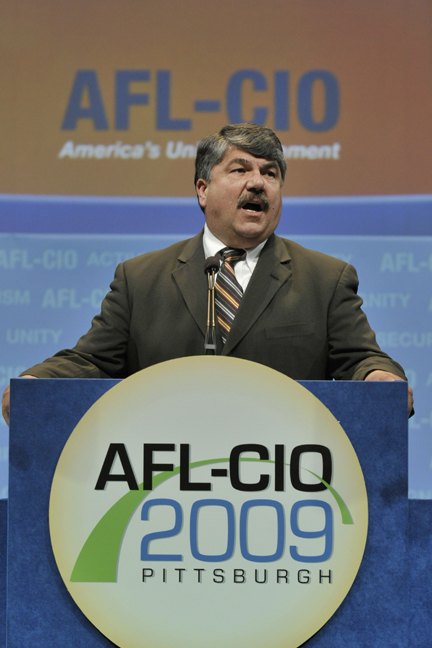
The outcome of this step would be a dismantling of the AFL-CIO, SEIU, and Change to Win Federation.  In addition, no one union could represent all the employees in a particular trade at a single company.  Therefore, more than one union would be required; in cases where no additional union is ratified, at least a portion of the employees would not be unionized.  In all cases, the unions would be forced to compete with one another for members.  Competition would tend to put downward pressure on dues and inherently limit the amount of money available for political manipulation.

This solution is effectively a compromise in that it still allows a closed shop for unions, it preserves worker’s rights to unionize, and it gives workers greater choice in representation.  Finally, from the perspective of the firms, there would be competition in the labor market giving the companies greater flexibility over the compensation packages.  In turn, this helps prevent ludicrous pension benefits, exorbitant wages for menial labor, and ultimately makes the U.S. manufacturing industry more competitive against a world of low priced alternatives. 

Read more like this at Aaron Opine

Thursday, November 3

The Union Fix - Part 1

Photo by Bill Burke
Any non-imbecile can tell you that unions have exacerbated the decline in manufacturing in the United States.  Their demands made upon the threat of work stoppages have enabled them to amass pension funds that have crippled the likes of Ford, GM, and Chrysler.  Many States and municipalities are likewise stumbling under the weight of massive public employee union pension programs.  Like the foreign substance invading a festering wound, we must winnow the power of unions in our country to restore our predominance in manufacturing. There are two key steps towards stripping unions of their power and influence in order to reinstate our manufacturing base and thereby strengthen our economy (Note that addressing the unions must be done in concert with far reaching tax and regulatory reform – resolving our union problem with not be sufficient alone).  The first is immediate action to be taken by sensible persons holding unions positions; the second is longer-term and can only be accomplished at the State and Federal levels.

The first step is for all concerned union represented employees to become objectors.  When I graduated from college I went to work for a company that was infected with an agency shop union.  Initially, I chose to be a Beck Objector (see Communication Workers of America v. Beck for legal history), but still paid an “agency fee” which was nearly as much as the full union dues.  About a year later I learned that a significant portion of my agency fee was being used as campaign contributions towards democratic candidates.  Under Section 701(j) of Title VII of the Civil Rights Act of 1967, employees with bona fide religions objections cannot be coerced into supporting unions.  I wrote a letter to the union showing how every candidate supported by my fees was an abortion advocate.  I concluded by confirming that I view abortion as an unethical and abhorrent per my religious convictions.  The union agreed (as required by law) to allow me to contribute to a non-religious charity of my choice instead of paying union dues.

Although not all union represented employees are similarly inclined to depose of unions, it is quite likely that many would be put off by their union’s prolific use of union dues to support the campaigns of politicians and legislation that offends their religious sensibilities.  Therefore I encourage all union employees to investigate how their dues are spent – following the paper trail all the way to the AFL-CIO if necessary.  With the veil of faux-legitimacy lifted, I’m willing to wager many more union employees would become religious objectors.  Doing so would strip unions of the more than $400 Million they spend annually on political influence that has effectually stripped our nation of its competitiveness and propelled us closer to socio-Marxism.

For more information about becoming a Religious Objector I encourage you, or your union worker friends, to visit www.choosecharity.org and www.nrtw.org.

This step is critical and immediate.  However, it is not sufficient to curtail the influence, and therefore damage, of unions over our government.  Next week I will share step two – a longer term solutions with greater reach and impact.

READ MORE LIKE THIS AT AARON OPINE

RINO Blog Watch (Blog)

RINO Forum - User Submitted News

RINO Forum - Elections

Recent Posts

Contact Form

Name

Email *

Message *

Views (since Blogger started counting)

Blog Archives

Content.ad - Widget 13

Click Here To Become A Conservative Blogs Central Blogger

Back to TOP